How the shortlist works
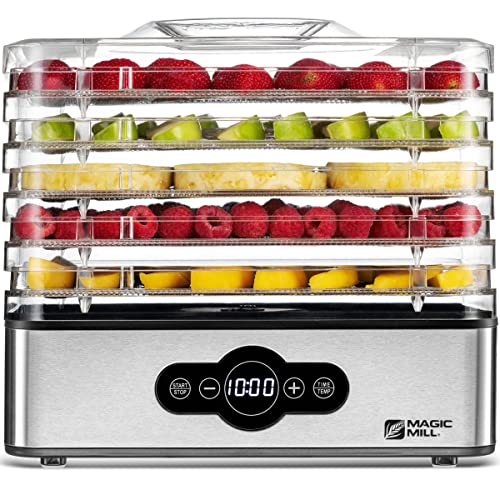
Every product shows a published editorial rating calculated from its stored listing documentation. Our everyday group contains five exact listings whose seller feature text states five or six included trays. The batch group contains five different listings whose feature text states eight or ten trays. The accessory group covers mesh inserts, fruit roll sheets and replacement racks. We review exact titles and feature text; a change invalidates selection until reviewed again. Each group starts in descending editorial-score order. Tray count does not prove usable area, drying speed or food suitability.
The title button toggles title order; the rating button restores the default rating order, descending. Position numbers identify rows; they are not a quality rank. We do not infer tray dimensions, temperature accuracy, cleaning compatibility or drying speed from a product name. Published seller features remain attributed to the listing.
Where the exact Amazon listing text states both a tray count and a heater wattage with explicit units, our documented spec-fit score is 100 × [0.6 × min(stated trays / 10, 1) + 0.4 × min(stated watts / 1,000, 1)], rounded to a whole number and shown as a 0–10 rating. Only wattages between 200 and 2,000 W are treated as heater ratings. Listings missing either stated value use the documentation completeness score below instead; ties use the product slug. Tray count and wattage are seller capacity claims, not drying-performance measurements, and this index is not a customer review.
Where a listing has no documented spec-fit inputs, our documentation completeness score is 100 × [0.5 × min(documented feature bullets / 8, 1) + 0.3 × min(product images / 5, 1) + 0.2 × (brand documented ? 1 : 0)], rounded to a whole number and shown as a 0–10 rating. Every input is read from the stored Amazon listing record, so the same listing always produces the same score. This measures how completely the listing is documented — it is not a performance test, a quality measurement or a customer review.
Where Amazon publicly displays customer reviews for a listing (average star rating and review count captured from the public product page), the raw editorial score is 100 × [0.45 × (Amazon average / 5) × min(review count / 50, 1) + 0.35 × min(log10(1 + review count) / log10(1 + 5000), 1) + 0.20 × documentation score / 100]. The confidence factor min(review count / 50, 1) damps averages based on very few reviews, and the logarithmic volume term rewards large public review volumes, so widely and highly reviewed listings rank ahead of thinly reviewed ones. Listings with no captured public review data use the documentation score alone. This combined index reflects the public Amazon reputation and the listing documentation — it is not a physical test and not our own product testing.
Formula-calculated scores use the raw result divided by ten. The publisher-assigned score below is a separate editorial judgment, not the output of the Amazon-review formula. The published shortlist and its order are retained.
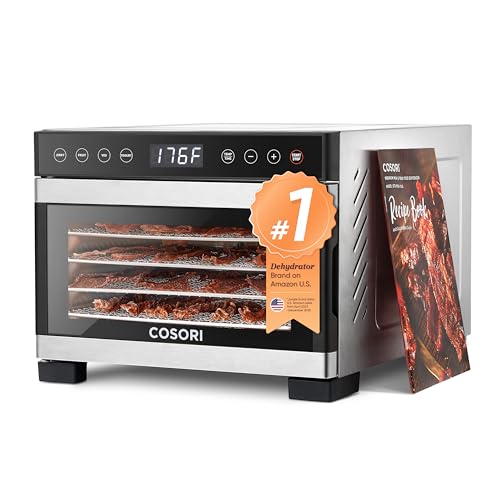
Publisher-assigned rating: Cosori Food Dehydrator: 9.4/10 — manually assigned by Elias, the publisher, as the editorial rating of the first-ranked listing on this comparison (publisher_assigned). It is a subjective editorial judgment, not the output of the Amazon-review formula, not an Amazon customer rating and not a physical test result. The value sits between 9.1 and 9.4 and is stepped from the listing's unchanged formula score, as described in our methodology. The shortlist and its order, the Amazon review counts, customer averages and underlying calculated scores are unchanged; cards, summaries and table use this same displayed rating.