Beef jerky from a home dehydrator is mostly a sequence problem. Slicing, marinating and drying are easy; the part people skip is the heat step that brings the meat to a safe internal temperature before or after drying. This guide walks through one complete batch using the published USDA and National Center for Home Food Preservation (NCHFP) methods, and shows where each instruction comes from. It is a process summary built from those sources, not a tested recipe of our own.
Can you make safe beef jerky in a dehydrator?
Short answer Yes, but the dehydrator alone is not the safety step. USDA FSIS recommends heating beef to an internal 160°F before dehydrating (165°F for poultry), then drying at a steady 130 to 140°F; NCHFP adds an alternative that heats the dried strips in a 275°F oven for 10 minutes. Slice lean beef no thicker than ¼ inch and dry until a cooled piece cracks but does not break when bent.
The reason is explained in the USDA's jerky fact sheet. Inside a dehydrator, evaporating moisture absorbs most of the heat, so the meat itself does not climb in temperature until much of the water is gone. By then, surviving bacteria have become more heat resistant. FSIS cites university research in which pathogenic E. coli survived drying times of up to 10 hours at temperatures up to 145°F, and notes that marinating alone did not significantly reduce the pathogen. A dial set to a jerky preset therefore cannot stand in for a measured internal temperature.
Our earlier jerky food-safety planning guide covers the decisions to make before you buy equipment. This article assumes you already own a dehydrator and want the step-by-step batch.
- Heat step: internal 160°F for beef, measured with a food thermometer (FSIS).
- Drying air: a dehydrator that holds at least 130 to 140°F throughout drying, ideally with an adjustable dial (FSIS).
- Slice: no thicker than ¼ inch, with visible fat trimmed (NCHFP).
- Done test: a cooled test piece cracks but does not break when bent (NCHFP).
Sources: USDA FSIS: Jerky and Food Safety; NCHFP: Jerky.
Choose and slice the beef
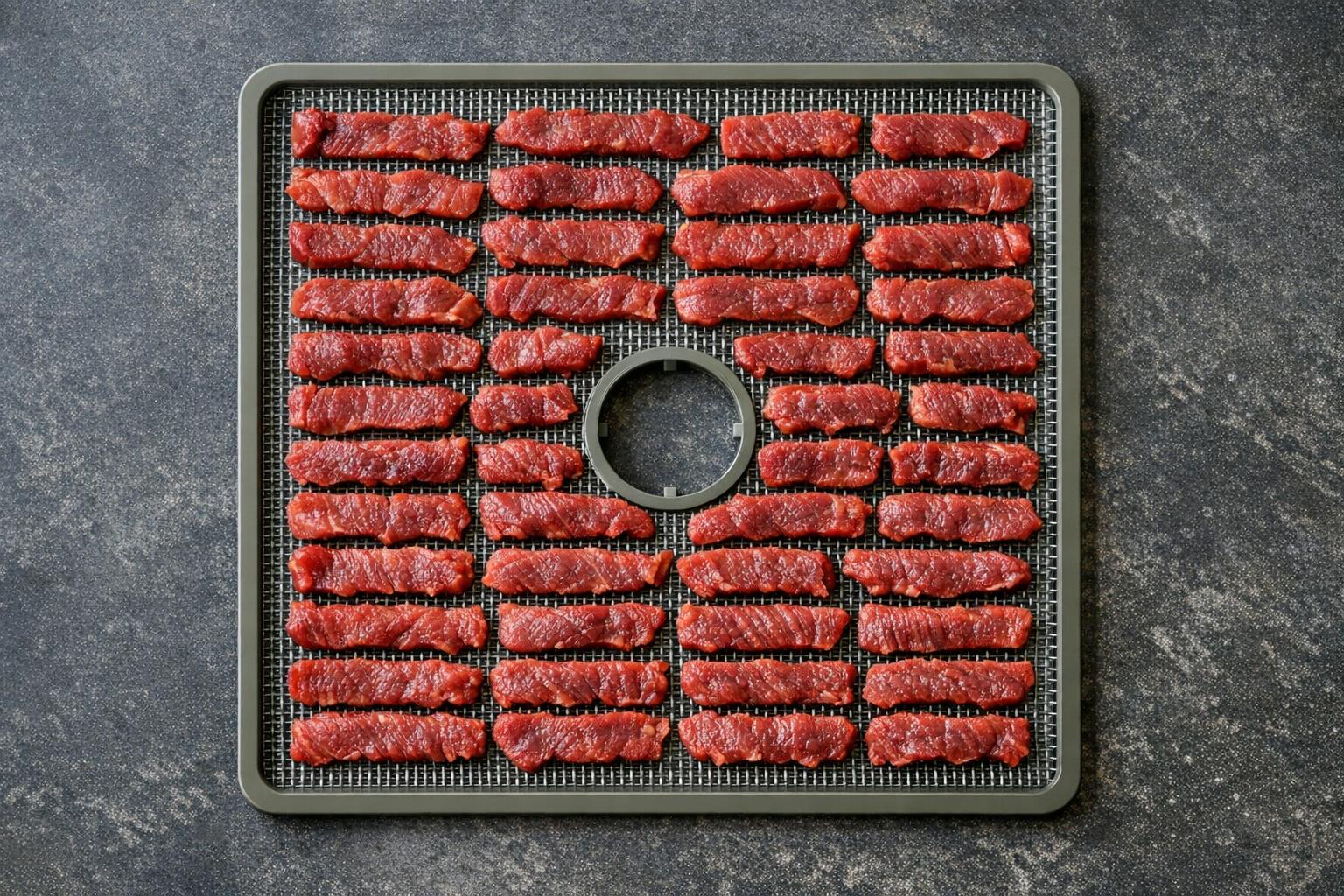
Start with lean meat. NCHFP says to trim and discard all fat because it becomes rancid quickly, and University of Wyoming Extension adds that only lean meat in excellent condition should be used. Keep the beef refrigerated at 40°F or below until you slice it; FSIS advises using whole cuts of red meat within 3 to 5 days, and ground beef within 2 days.
Partially freezing the meat makes thin, even slicing much easier. Aim for strips no thicker than ¼ inch. NCHFP explains that the grain changes texture: slicing with the grain gives a chewier jerky, while slicing across the grain gives a more tender, brittle one. Thickness matters for safety as well as texture, because the post-drying oven step described below is specified for strips cut ¼ inch thick or less.
- Whole muscle over ground: NCHFP notes that disease-causing microorganisms are more difficult to eliminate in ground meat than in whole strips.
- Thaw in the refrigerator: not on the counter (FSIS, NCHFP).
- Separate tools: keep raw-meat boards and knives away from ready-to-eat food, and wash hands for at least 20 seconds before and after handling raw meat (NCHFP).
- Pork or wild game: NCHFP calls for freezing a portion 6 inches thick or less at 0°F or below for at least 30 days to kill the trichinella parasite first; freezing does not remove bacteria.
If you plan to dry several cuts at once, sketch how the strips will sit on your trays before slicing. Our tray and liner guide explains how to check the usable area of a tray rather than its outside dimensions.
Marinate, then heat to 160°F
Marinades add flavor and tenderness, not safety. NCHFP's tested marinade combines soy sauce, Worcestershire sauce, black pepper, garlic powder, onion powder and hickory-smoked salt for 1½ to 2 pounds of lean meat, with the strips covered and refrigerated for 1 to 2 hours or overnight. Always marinate in the refrigerator and never reuse the marinade.
Next, choose one of the published heat steps. The three options below come from FSIS, NCHFP and University of Wyoming Extension; follow one completely rather than mixing parts of several.
| Option | What you do | Source |
|---|---|---|
| Heat in marinade before drying | Bring strips and marinade to a boil and boil 5 minutes; check several strips reach 160°F with a metal stem thermometer. Thicker strips may need longer. | NCHFP |
| Steam or roast before drying | Heat meat to 160°F (poultry 165°F), measured with a food thermometer, then dehydrate. | USDA FSIS |
| Oven-heat after drying | Place dried strips (cut ¼ inch or thinner) on a baking sheet in an oven preheated to 275°F for 10 minutes. | NCHFP; UW Extension |
| Vinegar soak before marinating | Extension-tested vinegar pretreatment; UW Extension says it is not recommended for game meat. | UW Extension |
NCHFP notes that strips heated in marinade dry faster, and that their color and texture differ from traditional jerky. That trade-off is the price of a measured safety step, and it is the main reason the method is worth writing down before you start. Our dehydrator temperature guide explains why an air setting and an internal food temperature are different measurements.
Load the trays and dry at 140°F
Drain the strips on clean absorbent towels. NCHFP says to arrange them close together but not touching or overlapping, then place them in a dehydrator preheated to 140°F. NCHFP's general dehydrator page describes these appliances as designed to dry foods at 140°F, and FSIS asks for a unit that maintains at least 130 to 140°F throughout drying.
- Start checking early: NCHFP says to begin checking samples after 3 hours.
- Expect a wide window: 10 to 24 hours for strips not heated in marinade; pre-heated strips dry faster (NCHFP).
- Blot fat: pat off any beads of oil with clean absorbent towels once drying is done.
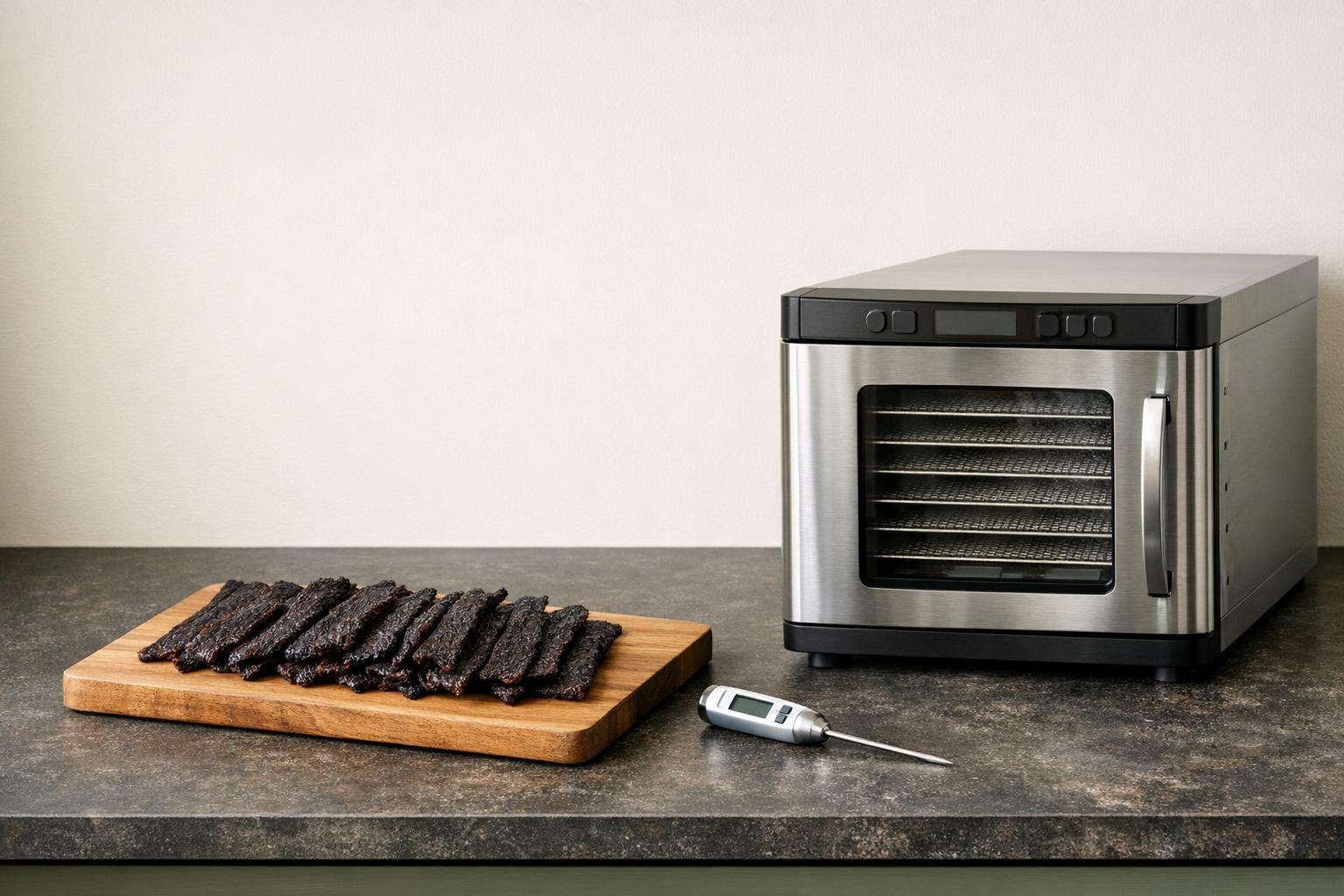
- Bend test: a cooled test piece should crack but not break when bent.
FSIS also notes that a pound of meat weighs about four ounces once it becomes jerky, which helps when planning how many trays one package will fill. Tray layout and airflow differ between models, so rotate or inspect according to your appliance manual. If you are still comparing machines with enough shelf area for meat batches, the batch-prep dehydrator comparison lists models by documented tray count and temperature range.
Cool, package and store the jerky
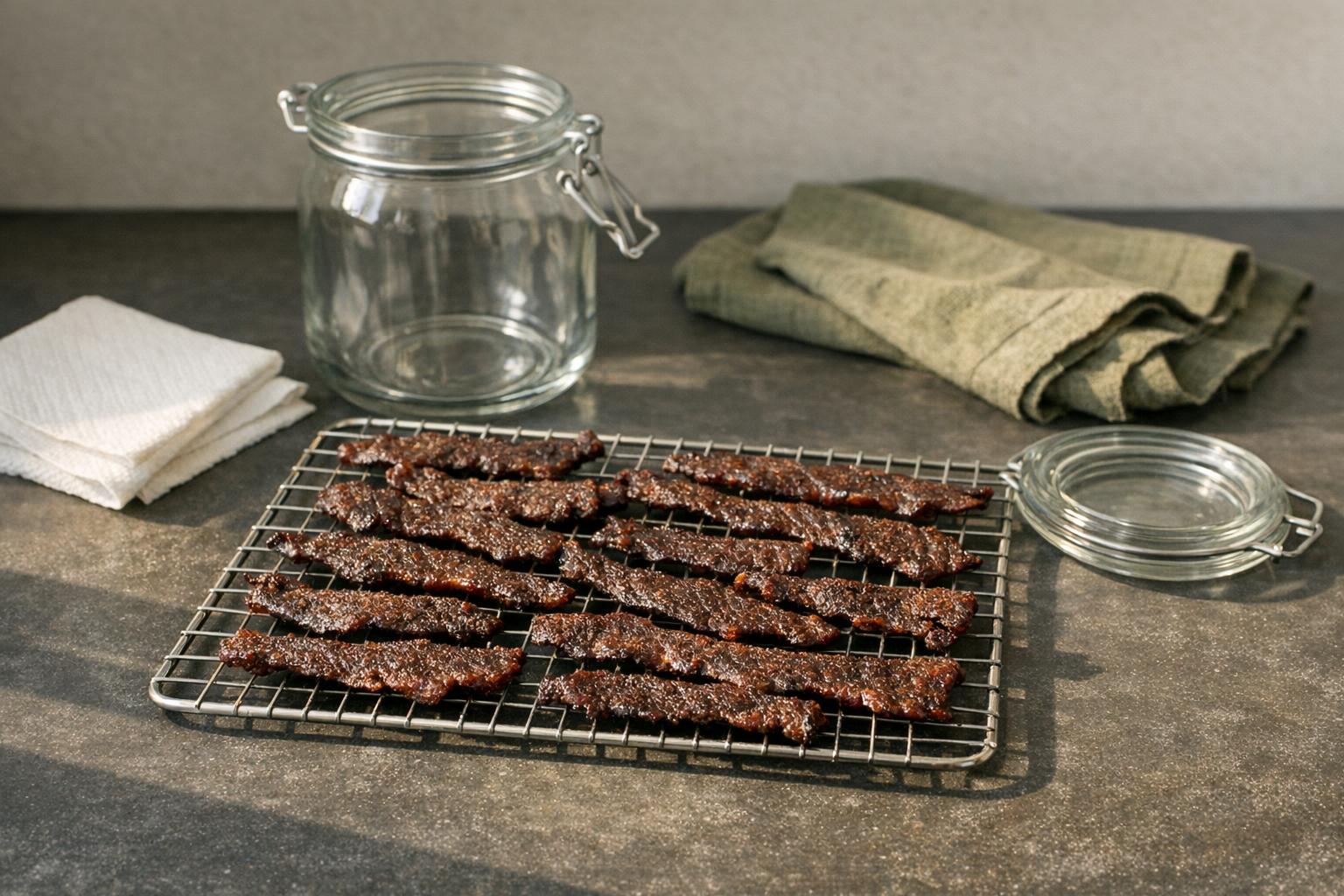
Let the strips cool on the racks, then package them in glass jars or heavy plastic food-storage bags; NCHFP lists vacuum packaging as a good option too. Label each container with the date and the heat-step method you used, so anyone eating it later knows how it was made. Our guide to storing dried food covers labels and container choices in more detail. If you want shelf life measured in years rather than weeks, that is a different appliance; see our freeze dryer vs dehydrator comparison.
Published storage guidance is short and not perfectly consistent between sources, so use the most conservative figure that applies to you:
| Source | Room temperature | Refrigerator / freezer |
|---|---|---|
| NCHFP | Two weeks in a sealed container | Refrigerate or freeze for longer shelf life and best flavor |
| University of Wyoming Extension | Two weeks | Up to 6 months refrigerated; up to 1 year frozen |
| USDA FSIS | Home-dried jerky: 1 to 2 months (commercially packaged: 12 months) | |
UW Extension also advises checking stored jerky occasionally for mold and discarding it if any appears. After the last tray comes out, clean the trays and the work area following your appliance instructions; our dehydrator cleaning guide separates washable parts from the electrical base.
Common jerky mistakes to avoid
Most problems come from treating convenience as a harmless change to a tested method. The sources above point to a few recurring ones:
- Skipping the heat step: FSIS explains that most dehydrator instructions omit it and that a dehydrator may not heat meat to 160°F on its own.
- Cutting thick strips: the 275°F/10-minute oven step is specified for strips cut ¼ inch or thinner; thicker strips may need longer to reach 160°F (NCHFP).
- Starting in a cold dehydrator: NCHFP calls for a unit preheated to 140°F.
- Overlapping strips: pieces should be close but not touching (NCHFP).
- Reusing marinade: discard it after use (FSIS, NCHFP).
If you also want to dry treats for a dog from the same equipment, read our separate guide on how to dehydrate dog treats: seasoned human jerky is not the same product, because ingredients such as onion and garlic powder are on the ASPCA list of foods to keep away from pets.
Sources: University of Wyoming Extension: Making Safe Jerky; NCHFP: Food Dehydrators.